
- BuildPadAI rapid application development for secure, tailored internal tools.
- Chocolate FactoryAgentic AI platform to observe, teach and configure your agents.
- Cloud PrimusOne control plane for AI and cloud, with cost control built in.
- SentryPageIntelligent website defacement monitoring that catches changes fast.
- VisorOne AI-powered CMS for every enterprise website you run.
Personalised Advice at Scale
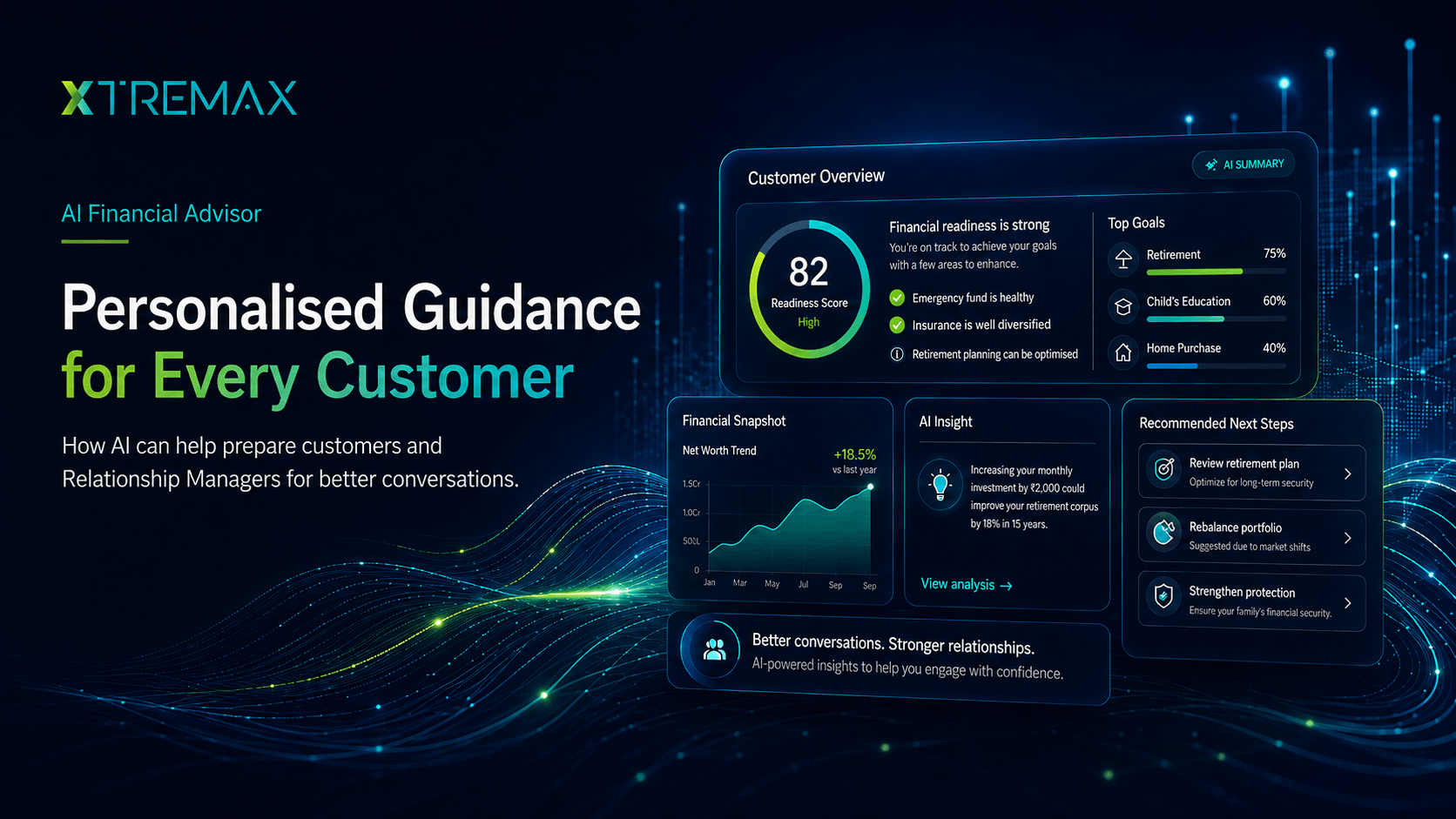
How AI can bring private banking-level guidance to every customer, and where it has to stop.
The problem: banks know their customers well, and still send them all the same email
Every customer has a question.
Can I afford this house?
Am I saving enough for my child's education?
What happens to my plan if rates move?
Should I be doing something different with this money?
These questions are the reason retail banking exists. They are also the questions most customers never get to ask a person.
A relationship manager can only carry so many clients. So the best banking experience is reserved for the top ten or twenty percent of the book, and everyone else receives a brochure and a campaign email.
The challenge is not that the bank does not know the answer.
The bank already holds the profile, the product holdings, the transaction behaviour and the life-stage signals. All of it sits there, unused, because nobody has the capacity to act on it one customer at a time.
This creates pressure for everyone.
Customers guess, or ask a group chat.
Relationship managers spend their hours on routine questions instead of the conversations that need judgement.
Banks see flat product fit, low engagement, and attrition they could have seen coming.
So the question becomes simple:
What if every customer could arrive at the conversation already prepared, and every relationship manager could open a customer already understood?
The customer journey today is still one-size-fits-all
In most banks, the journey follows a familiar path.
Open an account.
Receive a campaign email.
Have a question.
Search online or ask for a friend.
Maybe call the branch.
Wait.
Receive a generic answer, or a product pitch.
This process works, but it is not always useful.
Customers explain their situation from the beginning every time they ask anything. Relationship managers re-derive context that the bank already has on file. And the bank carries the operational impact through inconsistent documentation, slow response, and engagement concentrated in a thin slice of the customer base.
The result is a relationship where everyone is busy, but most customers are never really served.
Introducing the AI Financial Advisor
The AI Financial Advisor is designed to make the questions between conversations useful.
Instead of waiting for a call that is not coming, a customer can ask what they actually want to know, at the moment they want to know it.
The experience is simple.
The customer opens the bank's app, website or messaging channel.
They ask their question in their own words.
No form, no branch visit, no appointment.
From there, the assistant guides them through a natural conversation about goals, timelines, trade-offs and what their options actually mean, drawing on what the bank already knows about them.
And it is precise about where it stops.
The assistant educates and prepares. It does not give financial advice, and it does not recommend products to customers. The moment a question needs a licensed human, it goes to one, with the whole conversation attached.
How it works
The solution follows four simple steps.
Ask
The customer starts with their own question, in their own words, at any hour.
There is no form to complete and no appointment to book. The experience is lightweight and reaches the customer where they already are: the mobile app, the website, or a messaging channel.
The goal is to remove the friction that stops most customers from ever asking. A question at eleven at night is the most honest one a customer will ask all year.
Understand
The system assembles what the bank already knows into a single picture.
This may include the customer's profile, stated goals, product holdings, transaction behaviour and life-stage events, drawn from core banking, CRM and the bank's own customer data.
Instead of guidance aimed at a segment, the conversation fits this person. A thirty-two-year-old saving for a first home, a parent planning school fees and a pre-retiree are three different conversations, not one campaign.
Guide
The assistant explains what the customer actually asked about, at the point they asked it, in language matched to what they already understand.
It works inside an approved envelope: approved content, approved products, and the disclosures the bank requires, configured by the bank's own compliance team and enforced on every response rather than reviewed afterwards.
This is the difference between personalisation a bank can defend and personalisation a bank has to apologise for.
Hand over
When a question needs a licensed human, the assistant hands it to one.
A product recommendation, a complaint, a complex or sensitive case, anything outside what it is approved to discuss. The relationship manager receives the customer along with their goal, their timeline and everything they have been asking.
This is a feature, not a limitation. The hand-off is what makes the rest of it safe to deploy, and it is where the relationship manager's time becomes valuable again.
A simple example: Dian's question
Imagine Dian, 32, a customer at a retail bank.
Recently married. Wants to buy a house in three years. Has a salary account, a small deposit, and no idea whether she is on track.
In the current process, Dian receives a campaign email about a mortgage promotion and deletes it, because she does not know whether it applies to her. She is not in the top tier of the book, so no one calls.
With the AI Financial Advisor, she asks at eleven at night.
The assistant asks about her timeline, her target, what she is putting aside each month and what else she is committed to. It draws on what the bank already holds: her salary credits, her deposit, her spending pattern.
It explains how a down payment, a tenure and a monthly instalment relate to one another. What changing her savings rate would do to her three-year timeline. What a mortgage application would ask her for, and what she can prepare now.
It does not tell her which mortgage to take.
When she asks that question, it hands her to Rangga, her relationship manager, with her goal, her timeline and everything she has been asking already summarised.
Rangga opens a customer who already knows what she is asking for.
Instead of spending the call collecting her situation, he can spend it on her decision.
The impact: preparation on both sides
The value of an AI financial advisor is not only availability.
It is preparation.
For customers, it means an answer at the moment of the question, and guidance that fits their situation rather than their segment.
For relationship managers, it means fewer routine questions, a customer who arrives prepared, and hours returned to the conversations that need judgement.
For banks, it means engagement across the whole book rather than the top decile, more consistent documentation, and a complete record of what was said to whom.
When every conversation starts with context, the relationship manager is no longer starting from zero.
The result is not AI replacing the relationship manager.
The result is AI preparing both sides of the conversation.
That distinction matters.
Banking is built on trust, suitability and human judgement. AI should support that by reducing friction and improving readiness, not by taking over the regulated relationship.
Built to work inside your policy envelope
Personalisation and compliance are usually described as a trade-off. The more specific the guidance, the closer it moves to regulated advice, so most banks default to generic content, which is safe and largely useless.
The way out is not to be vaguer. It is to make the boundary explicit, configurable and enforced.
The AI Financial Advisor is designed so that:
- Only approved content and approved products are ever in scope, and the envelope is defined by the bank's compliance team, not by us.
- Required disclosures are part of the response, not appended to it.
- The assistant recognises when a question needs a licensed human and stops, rather than answering as far as it can.
- Product suggestions surface to the relationship manager, who decides. They never go straight to the customer.
- Consent and the bank's own rules on contacting customers are honoured on every channel.
- Every conversation, every piece of guidance and every hand-off is logged and reviewable.
- Customer data and model inference stay in the country, on infrastructure the bank accepts.
None of this makes a bank compliant. Compliance is the bank's own determination, and its compliance team signs off. What it does is make the boundary something they can see, configure and audit, instead of something they have to take on trust.
Powered by Chocolate Factory
The AI Financial Advisor is designed on Xtremax's Chocolate Factory agentic AI platform.
Chocolate Factory provides the foundation for building governed AI agents that can be configured, observed, improved and scaled across enterprise use cases.
For financial services this matters, because a financial assistant is not just a chatbot.
It must work with sensitive customer data.
It must connect with core banking and CRM systems.
It must retrieve the right context about the right customer.
It must stay inside an approved envelope on every single response.
It must know when to stop and who to hand to.
It must leave a complete and reviewable record.
Chocolate Factory supports this through capabilities such as:
- Configurable prompts and models
- Agent observability
- AI workflow orchestration
- Multi-agent platform design
- Integration with cloud AI services
- Governance, security and scalability
This allows financial institutions to move beyond isolated AI experiments and build AI capabilities that improve over time.
One agent today, many banking agents tomorrow
A customer-facing financial assistant is one example of what agentic AI can do in a bank.
The same platform approach can support many other agents, such as:
- Contact centre and customer service agents
- Complaint intake, classification and routing
- Document processing for onboarding and servicing
- Credit memo and file preparation support
- Collections and outreach preparation
- Internal policy and product question answering for staff
Each agent may solve a different operational challenge, but they should not be built as disconnected point solutions.
AI in financial services becomes more valuable when it is part of a shared platform that connects infrastructure, applications, data and AI into one transformation journey, with one governance model rather than six.
This is the role of the Xtremax Factory Approach.
Instead of building every solution from scratch, Xtremax uses proven platforms, accelerators and delivery experience to help organisations move faster while maintaining enterprise-grade governance, security and scalability.
Where this is today
Worth being direct, because it changes what this article is asking of you.
Chocolate Factory is in production. The conversational agents, the front-end platform and the messaging hand-off to a human are all running today in other regulated settings, including healthcare.
The AI Financial Advisor itself is a design. The customer context assembly, the policy envelope and the relationship manager's console have been specified in detail and have not been built, because the part that decides whether this works is not the technology. It is where a particular bank draws its own line between education and advice.
That line is not something a vendor should draw on a bank's behalf.
So we are looking for two or three banks to design this with, rather than customers to sell it to. The first conversation is not a demonstration. It is sitting down with your compliance team and mapping where your boundary actually sits.
Giving every customer a financial advisor
Banks do not need more channels.
They need customers who arrive prepared, relationship managers whose time goes to the conversations that need them, and a record of everything that was said.
The AI Financial Advisor moves routine questions and financial education to the moment the customer actually has the question, inside a boundary the bank defines.
By the time a conversation reaches a relationship manager, they have a clear picture of the customer's goal, situation, history and what they have been trying to work out.
The conversation becomes more focused.
The customer experience becomes more personal.
The bank gains reach it could not previously staff for.
AI does not replace the relationship manager.
AI prepares both sides of the conversation.
And when both sides are prepared, the bank can finally give every customer something close to what its best customers have always had.
Ready to explore what a governed AI assistant would look like in your institution? We are selecting a small number of design partners. Reach out to Xtremax at contact@xtremax.com to start the conversation.
AI Financial Advisor provides financial education and preparation. It does not provide financial advice, and it does not make product recommendations to customers. Recommendations are surfaced to a qualified human, who decides. Deployment is configured to the bank's own approved policies and is subject to the bank's compliance sign-off.