
- BuildPadAI rapid application development for secure, tailored internal tools.
- Chocolate FactoryAgentic AI platform to observe, teach and configure your agents.
- Cloud PrimusOne control plane for AI and cloud, with cost control built in.
- SentryPageIntelligent website defacement monitoring that catches changes fast.
- VisorOne AI-powered CMS for every enterprise website you run.
AI-Assisted Claim Management: Transforming Document-Intensive Insurance Claims Processing
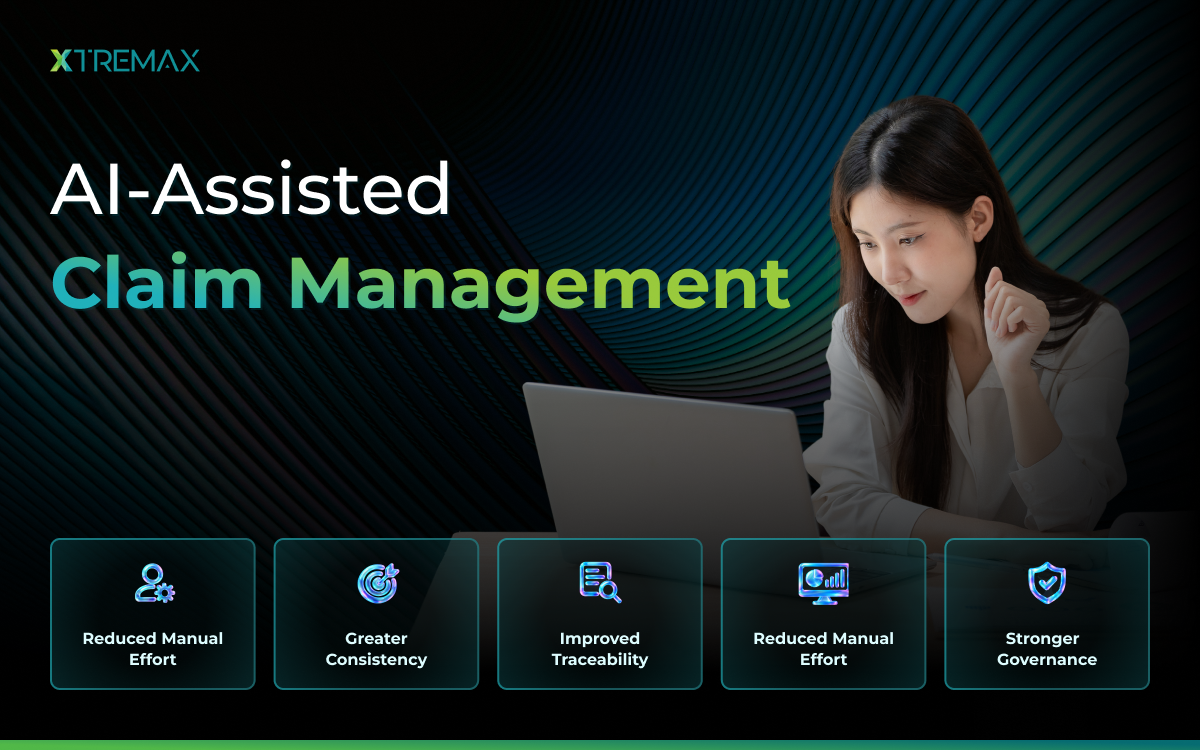
When a Claim Is More Than Just a Form
For claimants, filing an insurance claim often feels straightforward: submit the required documents and wait for the outcome.
Behind the scenes, however, claims teams face a far more complex reality.
A single claim can involve numerous documents, including application forms, medical reports, invoices, prescriptions, receipts, supporting evidence, and verification records. Each document must be reviewed, validated, cross-referenced, and assessed before a claim can move forward.
As claim volumes grow and documentation becomes increasingly complex, organisations face a key challenge: how can they process claims efficiently without compromising accuracy, compliance, or governance?
In collaboration with a leading social security institution, Xtremax explored how Artificial Intelligence (AI) can support document-intensive claim verification processes while ensuring human reviewers remain at the centre of every critical decision.
The result is an AI-assisted Claim Management framework designed to streamline claims processing, improve operational visibility, and strengthen governance across the entire verification journey.
The Growing Complexity of Insurance Claims Processing
Claims verification is fundamentally an information management challenge.
Claims officers frequently need to:
- Review information across multiple documents
- Verify eligibility and coverage requirements
- Cross-check supporting evidence
- Identify inconsistencies or missing information
- Record findings and recommendations
- Maintain audit trails for compliance purposes
When these activities are performed manually, they can become time-consuming and difficult to scale.
Organisations often encounter challenges such as:
- Repetitive document review activities
- Inconsistent verification processes
- Limited visibility into claim progress
- Difficulty tracking exceptions and escalations
- Increased operational workloads during peak claim periods
The question is no longer whether AI can process documents.
The real opportunity lies in how AI can assist claims teams by organising information, identifying exceptions, and supporting verification workflows while preserving accountability and human oversight.
Why Human Oversight Remains Essential
In insurance and social security claims processing, decisions have real consequences for individuals and families.
For this reason, efficiency cannot come at the expense of transparency, governance, or control.
Any AI-powered solution must support decision-making, not replace it.
Human reviewers remain responsible for:
- Evaluating claim eligibility
- Making approval decisions
- Handling exceptions and edge cases
- Ensuring compliance with regulations and policies
The objective is not to automate judgement. It is to empower claims professionals with better information, better visibility, and better tools.
An AI-Assisted Claim Management Framework
To address these challenges, Xtremax designed an AI-assisted Claim Management framework tailored to an organisation's claim verification requirements.
The solution combines:
- Intelligent document processing
- AI-assisted verification
- Business rule validation
- Operational monitoring
- Reporting and analytics
- Governance and security controls
Rather than making claim decisions automatically, the platform supports information-intensive tasks throughout the verification process.
This enables claims teams to spend less time searching for information and more time focusing on assessments that require human expertise.
From Documents to Structured Data
One of the biggest challenges in claims processing is that information is often spread across multiple formats and documents.
Important claim data can be contained within:
- PDFs
- Scanned forms
- Medical reports
- Invoices
- Receipts
- Supporting attachments
The first step in the workflow is converting these unstructured documents into structured, searchable digital information.
By extracting and organising relevant data, the solution creates a unified view of the claim.
This reduces manual document navigation and provides reviewers with faster access to the information they need for verification and assessment.
AI-Assisted Verification and Smart Recommendations
Once data has been extracted, it can be evaluated against configured business rules and reference information.
These may include:
Policy requirements
Eligibility criteria
Coverage information
Tariff references
Internal verification guidelines
Organisational business rules
Unlike generic automation tools, the verification workflow is tailored to the organisation's existing claims process.
The platform helps identify:
Missing information
Potential discrepancies
Inconsistent data
Verification exceptions
Claims requiring additional review
Most importantly, the system provides traceable findings rather than black-box decisions.
Claims reviewers can clearly see:
- What was checked
- What issues were identified
- Which rules were applied
- Why further review may be required
This transparency helps build trust while enabling reviewers to focus their attention where it matters most.
Improving Visibility Across the Claims Lifecycle
Beyond individual claim reviews, organisations also need visibility into overall operations.
The AI-assisted framework provides monitoring and reporting capabilities that enable teams to track:
- Claim processing status
- Verification outcomes
- Exception handling activities
- Operational performance trends
- Workflow bottlenecks
- Reporting metrics
This creates a more transparent claims environment where managers and stakeholders can better understand operational performance and identify opportunities for continuous improvement.
Governance and Security by Design
Claims information often contains highly sensitive personal and financial data.
As a result, security and governance must be embedded into every stage of the process.
The solution was designed to support:
- Secure cloud deployment
- Role-based access controls
- Auditability and traceability
- Compliance requirements
- Data governance policies
- Operational oversight mechanisms
This allows organisations to pursue AI innovation while maintaining the controls required for regulated business processes.
Business Benefits of AI-Assisted Claims Processing
Through this initiative, the organisation explored how AI can help strengthen claim verification operations in several key areas.
Reduced Manual Effort
Automating document extraction and information organisation reduces repetitive administrative tasks and allows reviewers to focus on higher-value work.
Greater Consistency
Configured verification rules help standardise reviews and improve consistency across claims processing scenarios.
Improved Traceability
Transparent findings and documented recommendations provide stronger auditability and easier review of verification outcomes.
Enhanced Operational Visibility
Monitoring dashboards and reporting capabilities provide real-time insight into processes, exceptions, and claim performance.
Stronger Governance
Integrated oversight mechanisms help organisations maintain compliance while introducing AI into critical operational workflows.
A Structured Approach from Discovery to Scale
Successful AI implementation requires more than technology. It requires a deep understanding of the underlying business process.
Xtremax follows a structured delivery approach:
- Discover
Identify existing workflows, document types, business rules, pain points, and operational objectives.
- Design
Define the future-state workflow, solution architecture, verification logic, and user experience.
- Configure & Build
Implement document extraction capabilities, validation mechanisms, dashboards, and supporting workflows.
- Pilot & Validate
Test the solution using real-world claim scenarios and gather feedback from business users.
- Operate & Scale
Optimise and expand the solution based on operational outcomes, new requirements, and future growth plans.
AI Success Starts with the Business Process
One of the most important lessons from this initiative is that successful AI adoption starts with understanding how work gets done.
Every insurance and social security organisation operates differently.
Claim types, document requirements, approval hierarchies, compliance obligations, and operational priorities can vary significantly.
For this reason, AI-assisted Claim Management should not be viewed as a one-size-fits-all product.
Instead, it serves as a configurable framework that can be adapted to an organisation's unique processes, governance requirements, and operational goals.
The technology provides the capability.
The business process determines how that capability creates value.
The Future of AI in Claims Verification
This initiative demonstrates how AI can be applied responsibly to support document-intensive claim verification.
By combining document digitisation, AI-assisted verification, configurable business rules, operational monitoring, and governance controls, organisations can improve how they manage information without removing human judgement from the decision-making process.
As claims operations continue to evolve, the greatest opportunities may not come from replacing people with AI, but from creating smarter workflows where AI and human expertise work together.
Explore AI-Assisted Claim Management for Your Organisation
Looking to modernise your claim verification process?
Discover how AI can help streamline document review, improve visibility, strengthen governance, and support faster, more informed decisions while keeping your experts in control.